

Best 3000W Portable Power Stations UK: Top Picks for 2026
A 3,000W portable power station sits in a useful middle ground for home backup, camping, motorhome and caravan trips, and demanding DIY work. It can provide enough continuous output for many appliances, while a battery capacity of around 2kWh or more gives you useful energy storage without moving into the size of a full home battery system.
However, the best 3000‑watt power station is not necessarily the one with the biggest inverter. Battery capacity, charging speed, solar input, UPS performance and expansion options can make a bigger difference to everyday use.
We compared five popular models to see how they differ and which type of user each one suits best.

Best Portable Power Station 3000W: Quick Comparison
Choosing a 3000W portable power station involves more than comparing inverter output. Battery capacity affects how long you can run your appliances, while solar and mains charging speeds determine how quickly you can replenish the battery. Expansion options can also be important if you want additional storage for longer power cuts or off‑grid trips.
The table below compares the five models across the specifications that matter most for home backup, camping, motorhome and caravan use in the UK.
| Model | Rated Output | Battery Capacity | Weight | Max Solar Input | Max AC Input | Expandable Capacity |
|---|---|---|---|---|---|---|
| Jackery Explorer 2000 Plus | 3,000W | 2,042.8Wh | 27.9kg | 1,400W | 1800W | Up to 12kWh |
| AFERIY Haven3000 P300 Portable Power Station | 3,000W | 2,048Wh | 21.6kg | 1,200W | 1,800W | Up to 10.24kWh |
| EcoFlow DELTA 3 Max Plus | 3,000W | 2,048Wh | 22.1kg | 1,000W | 2,300W | Up to 10kWh |
| BLUETTI AC300 + B300 | 3,000W | 3,072Wh | — | 2,400W | Up to 3,000W | Up to 12.29kWh |
| Anker SOLIX F3000 | 3,600W | 3,072Wh | 41.5kg | 2,400W | Up to 3,600W | Up to 12kWh |
Maximum AC charging depends on the charging configuration.
The comparison highlights several meaningful differences. The BLUETTI AC300 + B300 and Anker SOLIX F3000 offer the largest starting battery capacity at 3,072Wh, while the AFERIY P300 Portable Power Station and EcoFlow DELTA 3 Max Plus provide 2,048Wh. Solar charging also varies considerably, from 1,000W on the EcoFlow to 2,400W on the BLUETTI and Anker systems.
For UK buyers, it is also worth checking the exact regional specification before purchasing. Charging configurations, socket types, availability and other specifications can vary between markets. The figures above are based on manufacturer information for the relevant products.
What Matters When Choosing a 3000W Power Station?
Before comparing individual models, it helps to separate power output from battery capacity.
Output power
A 3,000W rating tells you how much power the inverter can supply continuously. This is important when running appliances such as kettles, microwaves, heaters, power tools and other high‑demand equipment.
It does not mean the power station will run a 3,000W appliance for one hour. For that, you need to look at battery capacity.
Battery capacity
Battery capacity is measured in watt‑hours (Wh). A 2,048Wh power station stores less energy than a 3,072Wh model, even when both have a 3,000W inverter.
For example, if you regularly need backup power for several hours, a larger battery may be more useful than a higher peak output.
Charging options
For UK users, mains charging is usually the most convenient way to recharge at home. Solar input becomes more useful for camping, motorhome and caravan trips or longer periods away from the grid.
If you expect to use your power station during extended outages, also consider how quickly it can recharge from the mains and whether you can add solar panels or extra batteries.
Expansion and UPS
Expandable batteries are useful if your energy requirements are likely to increase. UPS functionality is more relevant for home backup, particularly if you want to keep equipment such as routers, computers or other essential electronics running during a mains interruption.
5 Best 3000W Portable Power Stations
1. AFERIY Haven3000 P300 – Best Balance of Power and Portability
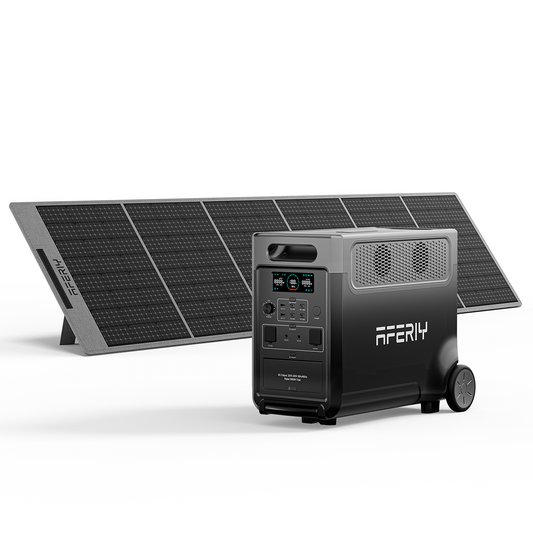
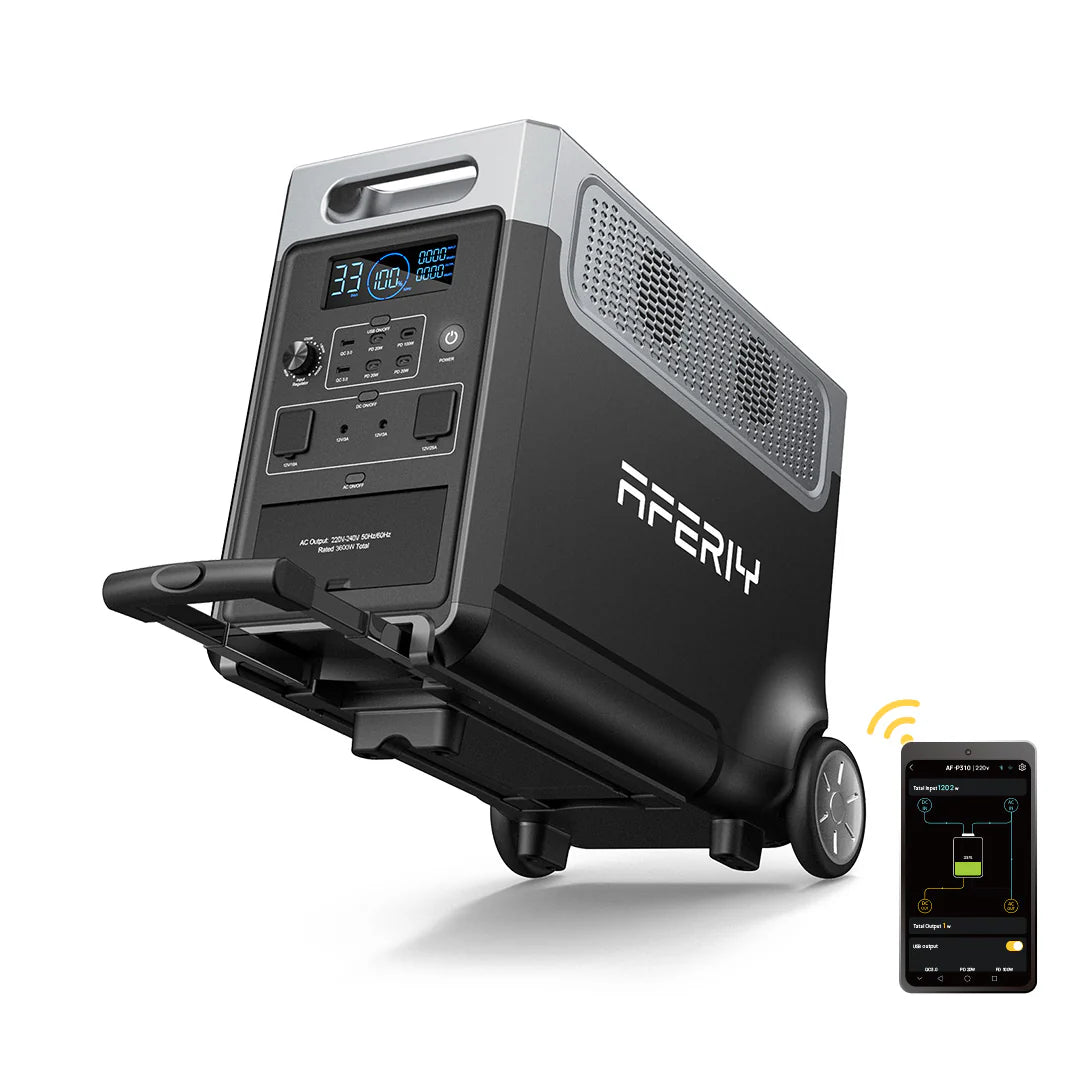
The AFERIY Haven3000 P300 Portable Power Station combines a 3,000W pure sine wave inverter with a 2,048Wh LiFePO₄ battery. Its capacity can be expanded to 10.24kWh with additional battery packs, providing more storage for longer backup periods.
The AFERIY P300 Portable Power Station supports up to 1,800W AC input and 1,200W solar input. AFERIY states that AC charging can recharge the battery in around 1.5 hours, while combined AC and solar charging can provide up to 2,000W of total input.

At 21.6kg, the AFERIY P300 Portable Power Station is relatively manageable for a 3,000W‑class power station. It also provides 220–240V AC output and a UPS function with a switching time of 10ms.
For UK households, motorhomes, caravans and outdoor use, the combination of 3,000W output, 2,048Wh capacity and expandable storage makes the P300 a versatile all‑round option.
Best for: Buyers looking for a balanced 3,000W portable power station for home backup, travel and outdoor use.
2. Jackery Explorer 2000 Plus – Best for Expandable Storage
The Jackery Explorer 2000 Plus provides up to 3,000W of output and starts with a battery capacity of around 2kWh. Its storage can be expanded to 12kWh with up to five additional battery packs, making it suitable for longer backup periods and extended off‑grid use.
Jackery uses a LiFePO₄ battery and states that the battery can retain 70% capacity after 4,000 charge cycles. The UK model also supports solar, wall and car charging. Jackery lists a wall‑charging time of around 1.7 hours and solar charging of around 2 hours under its specified conditions.

At 27.9kg, it is heavier than the AFERIY P300, although the integrated wheels and telescopic handle make it easier to move. The combination of 3,000W output and up to 12kWh of expandable storage makes it particularly interesting for users who may need more battery capacity later.
Best for: Users who want a 3,000W portable power station with substantial battery expansion.
3. EcoFlow DELTA 3 Max Plus – Best for Smart Energy Management
The EcoFlow DELTA 3 Max Plus delivers 3,000W of AC output and 6,000W of peak power from a 2,048Wh LFP battery. Its capacity can be expanded from 2kWh to 10kWh with compatible additional batteries.
The system supports up to 1,000W of solar input and 2,300W of AC charging input. Its UPS switches in less than 10ms, while Wi‑Fi, Bluetooth and the EcoFlow app provide remote monitoring and energy management features.

EcoFlow’s X‑Boost technology can support certain higher‑power appliances, but this should not be interpreted as a 3,800W continuous output rating. The DELTA 3 Max Plus remains a 3,000W continuous‑output power station.
Best for: Users who value smart controls, app‑based monitoring and fast mains charging.
4. BLUETTI AC300 + B300 – Best for Larger Home Backup Systems
The BLUETTI AC300 + B300 uses a modular design, separating the 3,000W inverter from the battery. The AC300 provides 3,000W continuous output, while the B300 supplies 3,072Wh of LiFePO₄ storage. A single AC300 can support up to four B300 batteries, taking the total capacity to 12,288Wh.
The system supports up to 2,400W of solar input and 3,000W of AC input. BLUETTI also states that the system can reach up to 5,400W of combined AC and solar input when using two or more B300 batteries.

The AC300 + B300 also features a 24/7 UPS function, making it particularly suited to home backup applications. For UK buyers, BLUETTI specifically states that split‑phase bonding is not supported on the UK version, so US‑specific split‑phase configurations should not be applied to the UK model.
Best for: Home backup users who priorities battery capacity, modular expansion and high solar input.
5. Anker SOLIX F3000 – Best for More Than 3000W
The Anker SOLIX F3000 moves beyond the standard 3,000W category with 3,600W of continuous output and 3,072Wh of battery capacity. It supports up to 2,400W of solar input and can be expanded from 3kWh to 12kWh with additional battery capacity.
Anker’s UK model weighs 41.5kg and uses a wheeled design with a pull handle. This makes it substantially heavier than the 2kWh‑class models above, but the higher output and larger battery are useful for demanding home backup and off‑grid applications.

For charging, the F3000 can accept up to 3,600W through an EV charger using Anker’s EV Charging Adapter. This should not be confused with standard mains charging, so the charging method should be considered when comparing it with other models.
Best for: Users who want more than 3,000W and need additional output for demanding appliances, tools or backup applications.
Which 3000W Power Station Is Right for You?
There is no single best portable power station 3000W for every situation.
For home backup, battery capacity and UPS performance deserve more attention than portability. A model such as the BLUETTI AC300 + B300 is particularly suited to users who want a modular system that can grow beyond 3kWh.
For motorhomes and caravans, weight, charging flexibility and battery expansion become more important. The AFERIY P300 Portable Power Station and Jackery Explorer 2000 Plus both provide 3,000W output while remaining portable enough to move when required.
For camping and off‑grid use, solar input is worth prioritising. The BLUETTI AC300 + B300 and Anker SOLIX F3000 both support up to 2,400W of solar input, although the actual solar energy available will depend on the panels, weather and installation.
For DIY and high‑power tools, additional output headroom can be useful. The Anker SOLIX F3000 provides 3,600W of continuous output, while the other models in this comparison are rated at 3,000W.
FAQs
Can a 3000W power station run a kettle in the UK?
Yes, a 3,000W power station can generally provide enough continuous output for a typical electric kettle, provided the kettle’s rated power is within the power station’s output limit.
The important point is that high‑power appliances consume battery energy quickly. A 3,000W inverter determines the maximum output, while the Wh rating determines how long the battery can supply that load.
How long will a 3000W power station last?
There is no single runtime for a 3,000W power station because runtime depends on the connected load and the battery capacity.
A 2,048Wh model and a 3,072Wh model will provide different runtimes even if both have a 3,000W inverter. Actual runtime will also be affected by inverter losses and the way the appliance operates.
Is 3000W enough for a caravan or motorhome?
For many caravan and motorhome applications, 3,000W provides substantial power for appliances and equipment. However, you should add up the running power of the appliances you expect to use at the same time and check their starting requirements.
You should also check the power station’s UK‑compatible output sockets and charging options before buying.
Should I choose 2kWh or 3kWh battery capacity?
Choose around 2kWh if portability and a lower initial capacity are more important. A 3kWh‑class system is more attractive when you need longer runtime between charges.
If your energy requirements may increase later, an expandable model can provide a middle ground because you can start with a smaller battery and add capacity when needed.
Conclusion
The best 3000W portable power stations offer different advantages depending on how you plan to use them. The AFERIY P300 Portable Power Station balances 3,000W output, 2,048Wh capacity, fast charging and portability. The Jackery Explorer 2000 Plus offers up to 12kWh of expandable storage, while the EcoFlow DELTA 3 Max Plus focuses on fast charging and smart controls. The BLUETTI AC300 + B300 is better suited to larger modular backup systems.
For users who need more than 3,000W, the Anker SOLIX F3000 provides 3,600W of continuous output and 3,072Wh of battery capacity.
Ultimately, the right portable power station 3000W should match your appliances, required backup time, charging options and future storage needs—not simply the highest wattage.