




How Much Do Solar Panels Cost for a House in the UK
Installing solar panels can reduce your reliance on grid electricity, but the upfront cost varies considerably between households. In 2026, a typical 4.5kWp domestic solar installation in the UK costs around £7,600, according to the Energy Saving Trust.
This guide covers UK solar panel prices, installation costs, available financial support and whether adding battery storage is worthwhile.

How Much Do Solar Panels Cost for a House in the UK?
The cost of a residential solar panel system depends largely on how much electricity your household uses. A smaller installation may suit a property with relatively low consumption, while a larger household may need additional panels to meet its daytime energy requirements.
The following estimates from Sunsave’s 2026 UK solar cost guide provide a useful comparison.
| Annual Electricity Use | System Size | 450W Panels | Estimated Installation Cost | With 10kWh Battery |
|---|---|---|---|---|
| 2,000kWh | 3.15kWp | 7 | £5,695 | £9,695 |
| 3,400kWh | 4.95kWp | 11 | £8,029 | £12,029 |
| 5,000kWh | 6.75kWp | 15 | £10,949 | £14,949 |
These are indicative 2026 UK market estimates, not guaranteed installer quotations. Battery-inclusive prices assume an additional estimated £4,000 for a 10kWh battery.
For a household using around 3,400kWh annually, a 4.95kWp system provides a useful budgeting reference. The final system size should also account for available roof space, daytime electricity use and future demand from appliances such as EV chargers.
How Much Does One Solar Panel Cost in the UK?
A single solar panel typically costs around £66–£150 for standard residential models in the UK, while some specialist panels cost over £300.
| Solar Panel Model | Wattage | Retail Price (Including VAT) |
|---|---|---|
| Anglo Solar | 435W | £66.00 |
| DMEGC | 465W | £79.00 |
| UKSOL | 460W | £82.00 |
| JA Solar | 465W | £96.60 |
| Jinko Solar | 470W | £120.46 |
| LONGi | 480W | £148.70 |
| Viridian | 445W | £320.40 |
These prices cover individual panels only. A complete rooftop installation also includes an inverter, mounting equipment, electrical connections and installation labour.
What Affects the Cost of Solar Panel Installation?
Even when two properties need similar system capacities, their installation quotes may differ considerably. The following factors account for much of that variation.
Roof Access and Condition
Roof accessibility can make a noticeable difference to installation costs. Scaffolding is usually required for rooftop installations, and properties with difficult access, multiple roof sections or unusual layouts may involve additional labour.
The condition of the roof is equally important. If tiles need replacing or structural repairs are required, it is generally better to complete this work before installing solar panels. Otherwise, removing and reinstalling the system later could increase the overall expense.
Solar Panel Efficiency and Equipment
Higher-efficiency panels can generate more electricity from a limited roof area, which is particularly useful for homes with restricted installation space.
The inverter is another important part of the system. It converts the DC electricity generated by solar panels into AC electricity used by household appliances. Its capacity and specifications should match the proposed installation.
Mounting equipment, electrical wiring and optional battery storage also contribute to the final quotation. Comparing these components helps you understand whether two installers are offering equivalent systems.
Household Electricity Consumption
Your household’s electricity consumption helps determine the capacity of the solar system you need. Properties with electric heating, tumble dryers, EV chargers and other energy-intensive appliances may require more generation capacity.
However, when you use electricity matters too. Solar panels generate most of their electricity during daylight hours. If your household is usually empty during the day and uses more electricity in the evening, you may export more surplus energy unless you have battery storage.
What Is Included in a Solar Panel Installation Quote?
A professional installation quote should clearly identify the main equipment and services included in the price.
| Component | Purpose |
|---|---|
| Solar panels | Generate DC electricity from daylight |
| Inverter | Converts DC electricity into AC electricity |
| Mounting equipment | Secures the panels to the roof |
| Electrical connections | Connects the system to household wiring |
| Scaffolding and labour | Provides safe roof access and installation |
| Commissioning and certification | Covers system testing and relevant documentation |
| Battery storage | Stores surplus electricity for later use, if selected |
Battery storage is optional, but it can increase the initial investment. UK market estimates put the additional cost at approximately £3,000–£7,000, depending on capacity, manufacturer and installation requirements.
Ask installers to price the solar-only system and the battery separately. This makes it easier to understand how much extra you are paying for storage.
How Can You Reduce the Cost of Solar Panels in the UK?
Choosing a suitable system and comparing installation offers can help you avoid unnecessary upfront expenses.
Compare installation quotes
Request at least three quotations from installers. Compare system capacity, panel and inverter models, scaffolding, labour charges and warranties. Make sure each quote covers the same installation requirements rather than comparing headline prices alone.
Check whether the installer is certified under the Microgeneration Certification Scheme (MCS). MCS certification is also commonly accepted by SEG providers when assessing eligibility for export payments.
Check VAT eligibility
In Great Britain, qualifying solar panel installations currently benefit from 0% VAT until 31 March 2027. Northern Ireland has different eligibility conditions, so check the relevant HMRC guidance before calculating potential savings.
Look into financial support
There are no universal grants available to every UK homeowner installing solar panels. However, eligible households may qualify for support through government energy-efficiency schemes. Check the latest eligibility requirements before including potential funding in your budget.
Compare export tariffs
Under the Smart Export Guarantee (SEG), eligible generators in Great Britain can receive payments for surplus electricity exported to the grid. Different suppliers offer different rates and contract terms, so compare available tariffs before choosing an export arrangement.
Are Solar Panels Worth It in the UK?
Solar panels can reduce household electricity bills, but the financial return depends on installation costs, electricity consumption and how much generated electricity you use yourself.
The Energy Saving Trust provides location-based payback estimates using July 2026 energy prices. Its figures range from approximately nine years in London to 11–12 years in Stirling, depending on household occupancy and export arrangements.
There are several ways to improve the value of your installation:
Increase self-consumption: Run washing machines, dishwashers and other appliances during daylight hours when solar generation is available.
Consider battery storage: Store surplus daytime electricity for use in the evening instead of relying entirely on grid electricity.
Compare SEG tariffs: Export payments vary between electricity suppliers, so choosing a competitive tariff can improve your overall return.
Account for replacement costs: Inverters and batteries may need replacing before the solar panels themselves, which can affect long-term savings.
Solar panels also generate electricity on cloudy days, although output is generally lower than in strong sunlight. Seasonal daylight hours, roof orientation and shading all affect annual generation.
Before deciding whether solar panels are worthwhile, compare the installation quotation with your expected electricity savings and export income. A system with a lower upfront cost is not necessarily the one that delivers the best long-term value.
Are There More Flexible Alternatives to Rooftop Solar Panels?
A permanent rooftop installation is not the only way to use solar energy. For households primarily interested in camping, caravanning or backup electricity during power cuts, portable solar equipment offers a different approach.
Portable Solar Panels for Flexible Power Needs
Portable solar panels can recharge compatible power stations without requiring permanent roof installation.
They are useful for outdoor activities, caravanning and off-grid applications. Their actual output depends on sunlight, positioning, shading and weather conditions.
Although they cannot normally replace a complete household solar installation, they offer a convenient way to generate electricity when travelling or away from home.
Portable Power Stations for Home Backup
For households that need backup electricity during a power cut, a portable power station paired with solar panels offers an alternative to permanent rooftop installation.
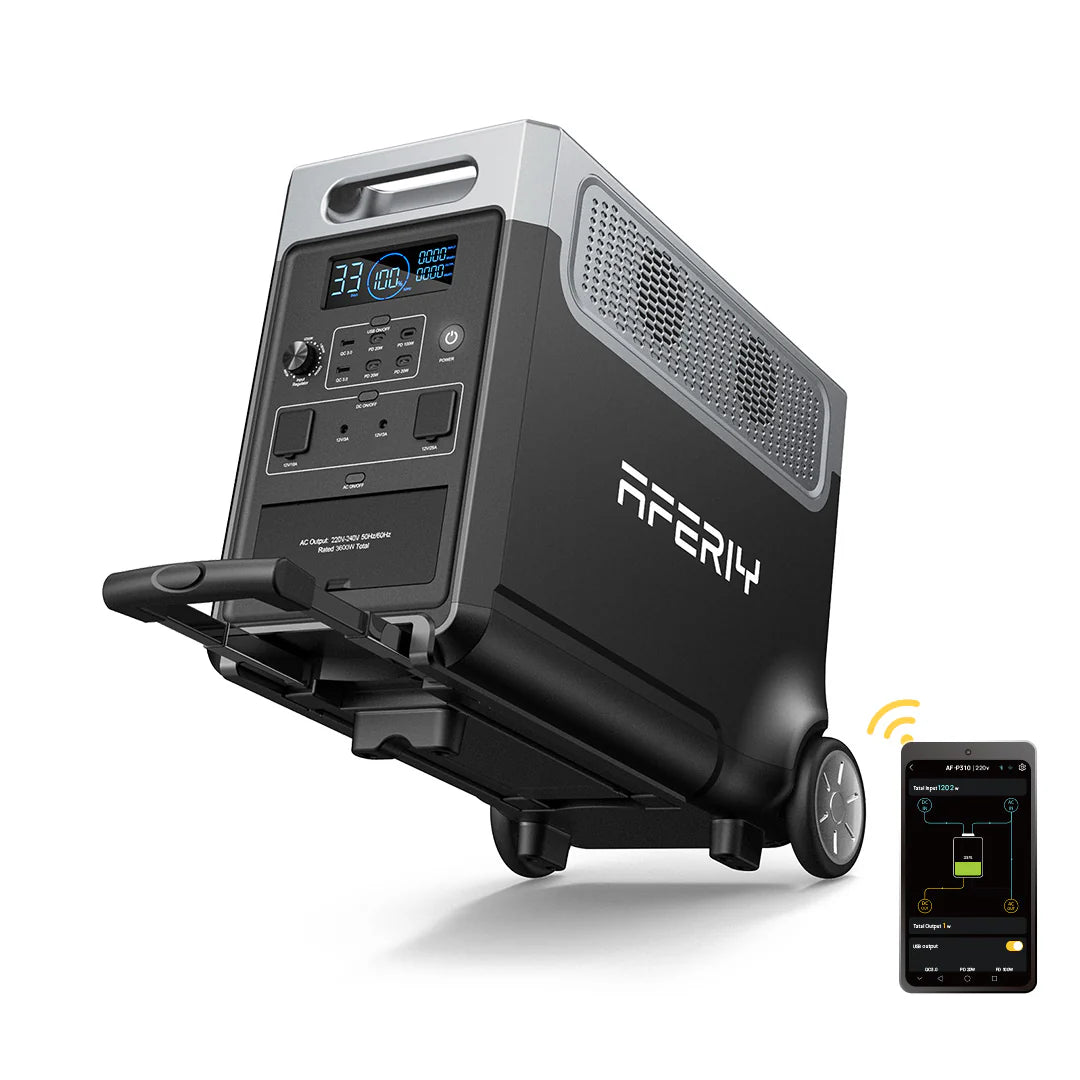
The AFERIY P310 Portable Power Station features a 3,840Wh LiFePO4 battery, a 3,600W pure sine wave inverter and up to 2,000W of solar input. Its capacity can expand to 11,520Wh with two compatible expansion batteries.
The UK version provides three 220–240V AC outlets, alongside USB and DC outputs. It can power compatible appliances such as refrigerators, washing machines, Wi-Fi routers and laptops, provided their combined running and starting power requirements remain within its specifications. Built-in wheels and a retractable handle make the 40kg unit easier to move, while compatible solar panels provide an additional charging option.

Unlike permanent rooftop systems, the AFERIY P310 Portable Power Station requires no fixed roof installation and can also be used for caravanning, camping and off-grid activities.
FAQs
Do solar panels work efficiently during winter in the UK?
Solar panels continue to generate electricity during winter, but shorter daylight hours and lower solar intensity generally reduce output. Snow, shading and poor weather can affect generation too. When budgeting for a system, use estimated annual generation rather than assuming the same output throughout the year.
How long do solar panels last?
Solar panels are designed for long-term use, and many manufacturers provide performance warranties extending to 25 years or more. However, the inverter and battery may need replacing earlier. Include potential equipment replacement costs when assessing the long-term value of an installation.
Can I install solar panels on an east- or west-facing roof?
Yes. South-facing roofs generally offer favourable generation conditions in the UK, but east- and west-facing roofs can also be suitable. They produce electricity at different times of the day, so the best layout depends on your roof space, shading and household consumption.
Will solar panels work during a power cut?
Most standard grid-connected solar systems automatically shut down during a power cut for safety reasons. A suitable battery system with backup functionality or a separate portable power station is needed to supply electricity during an outage.
Conclusion
Solar panel costs in the UK depend on system size, equipment and installation requirements. Compare installer quotations, check VAT eligibility and review SEG tariffs before investing. For households that mainly need backup electricity for selected appliances, the AFERIY P310 Portable Power Station with compatible solar panels offers a more flexible alternative.


