

How Long Will a 3000‑Watt Solar Generator Run?
If you’re considering a 3000‑watt solar generator for home backup, camping or a motorhome, one question matters more than the headline power rating: how long will it actually run your appliances?
The answer depends on more than the 3000W output. A solar generator’s battery capacity, the power draw of your appliances, inverter efficiency and whether you can recharge from solar all affect runtime.
A 3000W solar generator may run a television and a few lights for many hours, but a microwave, electric kettle or space heater can use much more power in a short period. Understanding the difference between power and stored energy makes it much easier to estimate how long your system will last.

How Long Does a 3000‑Watt Solar Generator Run?
There is no single runtime for a 3000‑watt solar generator. The 3000W figure describes the maximum continuous power the inverter can deliver; it does not tell you how much energy the battery stores.
Battery capacity is measured in watt‑hours (Wh). In simple terms, a higher Wh capacity means more stored energy available to run your appliances. Energy Saving Trust similarly distinguishes watts as a measure of how quickly energy is used from watt‑hours, which measure energy used over time.
For example, consider a 3000W solar generator with a 2,048Wh battery. Using an 85% efficiency factor for a practical estimate, the available energy would be approximately 1,741Wh.
| Total Appliance Load | Approximate Runtime |
|---|---|
| 200W | 8.7 hours |
| 500W | 3.5 hours |
| 1,000W | 1.7 hours |
| 1,500W | 1.2 hours |
| 2,000W | 0.9 hour |
| 2,500W | 0.7 hour |
| 3,000W | 0.6 hour |
These figures are estimates rather than guaranteed runtimes. Actual results vary with the efficiency of the power station, appliance behaviors, battery condition and other factors.
The important point is that 3000W determines how much power you can use at once, while battery capacity largely determines how long you can keep using it.
How to Calculate the Runtime of a 3000‑Watt Solar Generator
Once you know the battery capacity and the approximate power consumption of your appliances, you can make a useful runtime estimate.
The practical formula is:
Runtime (hours) = Battery Capacity (Wh) × Efficiency ÷ Appliance Load (W)
An efficiency factor of around 85% is commonly used for a conservative estimate when powering AC appliances through an inverter.
For example, suppose you have a 2,048Wh battery and want to power a 500W load:
2,048Wh × 0.85 ÷ 500W = approximately 3.5 hours
If the load drops to 250W, the estimated runtime roughly doubles:
2,048Wh × 0.85 ÷ 250W = approximately 7 hours
This is why reducing the load can make a surprisingly large difference. Turning off an unnecessary appliance or avoiding several high‑power appliances running together can extend the battery considerably.
It’s also worth checking the actual consumption of your equipment rather than relying entirely on a figure printed on the appliance. A smart meter or the power information shown by a compatible power station can give you a better idea of what you’re using in real time.
What Factors Affect the Runtime of a 3000‑Watt Solar Generator?
Battery Capacity
Battery capacity is one of the biggest factors affecting runtime. Two solar generators can both provide 3000W of output but have very different battery capacities.
For example, a 2,048Wh battery stores twice as much energy as a 1,024Wh battery. Assuming the same load and similar efficiency, the larger battery can theoretically provide about twice the runtime.
This is particularly important for overnight backup. If you’re trying to keep a fridge, router, lights and other essentials running for several hours, battery capacity can matter more than having a higher maximum output.
Appliance Power Consumption
The more power an appliance uses, the faster the battery will discharge.
A laptop or router may have a relatively modest power requirement, while an electric heater, kettle or microwave can draw substantially more power. Energy Saving Trust notes that appliances involved in heating or cooling tend to be among the more significant electricity users in UK homes.
This is why a generator that lasts all night with essential electronics may run for only a short time when a high‑power heating appliance is connected.
Inverter Efficiency
A solar generator doesn’t convert stored battery energy into AC electricity with 100% efficiency. Some energy is lost during the conversion process, mainly as heat.
That’s why simply dividing battery capacity by appliance wattage tends to give a more optimistic result than you’ll see in everyday use.
Starting Watts
Some appliances don’t draw the same amount of power continuously.
Refrigerators, freezers, air conditioners and certain power tools can require additional power when motors or compressors start. A solar generator therefore needs enough output capacity to handle both the normal running load and any starting demand.
This is separate from runtime: an appliance might be within the generator’s average power range but still fail to start if its initial demand exceeds the inverter’s capability.
Solar Charging Conditions
A solar generator can potentially keep running for longer when solar panels are producing electricity during the day. However, the amount of solar energy available changes with weather, season, shading, panel orientation and the system’s maximum solar input.
Solar panels can still generate electricity on cloudy days, although their output is lower than under stronger sunlight.
For extended backup, therefore, solar input should be considered alongside battery capacity rather than treated as a fixed source of power.
How Long Will a 3000‑Watt Solar Generator Run Common Appliances?
The easiest way to understand runtime is to look at everyday appliances.
| Appliance | Typical Power Range | Estimated Runtime with 2,048Wh* |
|---|---|---|
| Wi‑Fi router | 10–20W | 87–174 hours |
| Laptop | 40–100W | 17–44 hours |
| TV | 50–150W | 12–35 hours |
| Refrigerator | 100–200W | 9–17 hours+ |
| Coffee maker | 800–1,500W | 1.2–2.2 hours |
| Microwave | 1,000–1,500W | 1.2–1.7 hours |
| Space heater | 1,500W | ~1.2 hours |
| Electric kettle | 2,000–3,000W | 0.6–0.9 hour |
| Portable air conditioner | 800–1,500W | 1.2–2.2 hours |
For appliances such as refrigerators, looking only at the rated wattage can be misleading because the compressor does not necessarily operate continuously. Energy Saving Trust notes that fridges and freezers need to remain powered continuously, but their energy use depends on factors such as efficiency and operation.
The same principle applies to air conditioners. A unit may have a relatively high running demand, but its compressor cycles rather than operating at full power every minute.
For cooking appliances, the total time they are actually switched‑on matters. A kettle might use a high amount of power while heating, but if it runs for only a few minutes, its total energy consumption can still be relatively modest. Energy Saving Trust recommends only boiling the amount of water needed, which is a simple way to reduce electricity use.
What If Your 3000‑Watt Solar Generator Doesn’t Last Long Enough?
Sometimes the problem isn’t that a 3000W solar generator lacks enough output. It may simply not have enough stored energy for the length of time you need.
For example, a 2,048Wh battery can provide plenty of power for a combination of lower‑power essential appliances, but a heavy continuous load will consume that stored energy much faster.
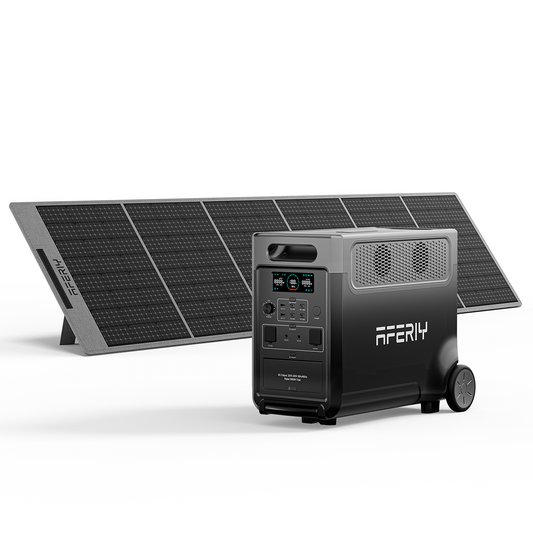
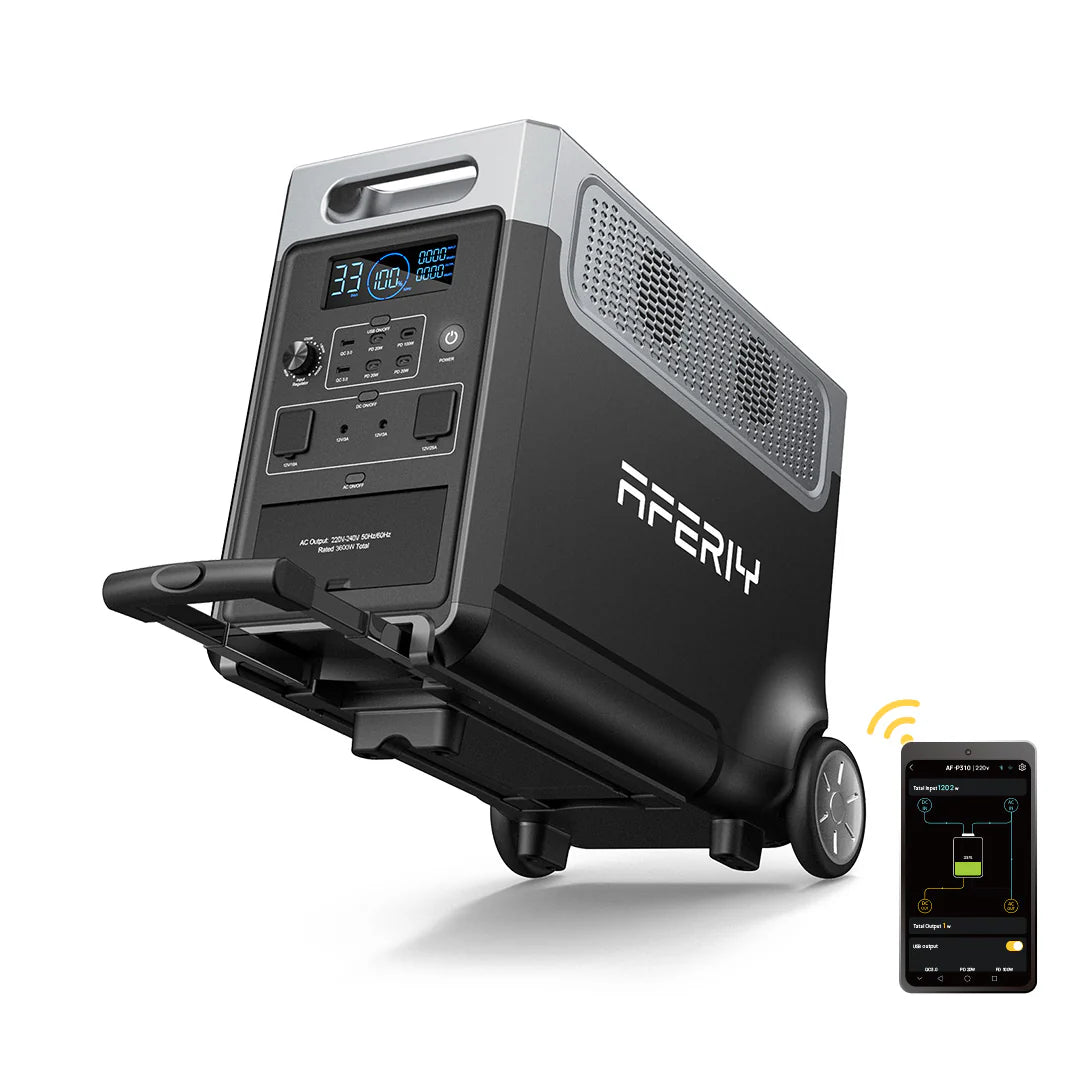
One solution is to choose a system with a larger battery capacity. The AFERIY Haven3000 P300 Portable Power Station, for example, combines a 3000W pure sine wave inverter with a 2,048Wh LiFePO₄ battery and allows the capacity to be expanded to 10,240Wh with additional batteries. It also supports up to 1,200W of solar input.

That expandable capacity is useful when your requirements change. A 2,048Wh configuration can suit shorter periods of backup, while additional storage can provide substantially more energy for longer outages, motorhome trips or off‑grid use.
Solar input can also reduce how quickly the stored battery energy is depleted during daylight hours. With suitable sunlight and compatible panels, some of the power being used by connected appliances can be supplied by the solar panels rather than coming entirely from the battery.
The key is to match the system to the actual problem. If the generator switches off because the connected appliances exceed 3000W, you need more output capacity. If it runs out of energy too quickly while staying below 3000W, increasing battery capacity is the more relevant solution.
FAQs
How long do solar generators last?
If you’re asking how long do solar generators last in terms of battery lifespan, it is different from runtime on a single charge. Runtime describes how many hours a generator can power your appliances before recharging, while battery lifespan refers to how many charge cycles the battery can provide before its usable capacity falls.
For example, the AFERIY P300 uses a LiFePO₄ battery rated for more than 4,000 charge and discharge cycles to 80% capacity.
How long does a solar generator last on one charge?
How long a solar generator lasts on one charge depends mainly on its battery capacity and the load connected to it. A larger battery running low‑power devices can last considerably longer than the same battery powering high‑demand appliances.
Use the runtime formula above to estimate your particular setup.
Can a 3000W solar generator run a fridge overnight?
It can, depending on the refrigerator’s actual energy consumption, the battery capacity and other devices connected at the same time. Because refrigerators cycle rather than continuously drawing their maximum rated power, actual energy use can differ from a simple wattage calculation.
Can a 3000W solar generator run a kettle and microwave?
Potentially, but you need to check their combined running power and the generator’s maximum output. Both appliances can be relatively high‑power loads, so running them simultaneously can consume battery energy quickly.
Is 3000W enough for home backup?
A 3000W system can be suitable for essential loads such as refrigeration, lighting, networking equipment, televisions, computers and selected kitchen appliances. It is less suitable for running several high‑demand appliances simultaneously, particularly electric heating, cooking or large air‑conditioning loads.
Conclusion
A 3000‑watt solar generator does not have one fixed runtime. The 3000W rating tells you how much power the system can deliver at once, while battery capacity in Wh tells you how much stored energy is available to use.
For a realistic estimate, consider battery capacity, actual appliance consumption, inverter efficiency, starting power and available solar input. A lower average load can significantly extend runtime, while a larger or expandable battery is more useful when longer backup periods are required.
In practical terms, choosing a solar generator is less about finding the biggest wattage number and more about matching output power and battery capacity to the appliances you actually need to run and how long you need them to stay on.