

How Many Watts Does a Window Air Conditioner Use?
A window air conditioner can be an effective way to cool a single bedroom, home office or living space without running a whole‑house system. But during a warm spell, it can also become one of the larger electricity loads in the room.
So, how many watts does a window air conditioner use? A typical window AC uses roughly 500–1,500 watts while operating, although the exact figure depends on its cooling capacity, efficiency and model. Smaller units generally use less power, while larger units require more.
Understanding air conditioner wattage is useful not only for estimating electricity costs, but also when choosing a backup power station for a power cut or off‑grid use.

How Many Watts Does a Window Air Conditioner Use?
A window air conditioner is a convenient way to cool a bedroom, home office or other individual room, but it can also be a noticeable electricity load. So, how many watts does a window air conditioner use?
One important distinction is that BTU and watts measure different things. BTU per hour describes cooling capacity, while watts describe electrical input. A higher‑BTU air conditioner does not automatically have a directly proportional wattage because efficiency varies between models.
Window AC Wattage by BTU
| Window AC Size | Cooling Capacity | Recommended Room Size* | Example EER | Estimated Input Power (Based on EER 10) | Typical Application |
|---|---|---|---|---|---|
| Small | 5,000 BTU/h | 100–150 sq ft | 10 | 500W | Small bedroom, home office |
| Small | 6,000 BTU/h | 150–250 sq ft | 10 | 600W | Bedroom, study |
| Small‑Medium | 7,000 BTU/h | 250–300 sq ft | 10 | 700W | Bedroom, small living room |
| Medium | 8,000 BTU/h | 300–350 sq ft | 10 | 800W | Bedroom, living room |
| Medium | 9,000 BTU/h | 350–400 sq ft | 10 | 900W | Medium living space |
| Medium | 10,000 BTU/h | 400–450 sq ft | 10 | 1,000W | Large bedroom, living room |
| Large | 12,000 BTU/h | 450–550 sq ft | 10 | 1,200W | Large living room |
| Large | 14,000 BTU/h | 550–700 sq ft | 10 | 1,400W | Large open room |
| Extra Large | 18,000 BTU/h | 700–1,000 sq ft | 10 | 1,800W | Large open‑plan space |
Room‑size recommendations are based on ENERGY STAR guidance under standard conditions. Factors such as ceiling height, sunlight and insulation can affect the appropriate cooling capacity.
Estimated input power = BTU/h ÷ EER. The EER 10 column is used only to demonstrate the calculation; it is not a universal rating for window AC units.
For a more efficient unit, the estimated input can be considerably lower. For example, an 8,000 BTU/h AC with an EER of 16 would require about 500W, compared with 800W at an EER of 10. Actual electrical consumption should always be checked against the manufacturer’s rated input.
The key takeaway is simple: BTU tells you how much cooling you get, while wattage tells you how much electrical power the unit needs to provide it.
How Much Electricity Does a Window AC Use?
The wattage of a window air conditioner tells you how much power it uses at a specific moment, but your electricity bill depends on how much energy it consumes over time.
To estimate energy usage, use this simple formula:
Energy Consumption (kWh) = Watts × Operating Hours ÷ 1,000
For example, if a window AC uses 1,000W and runs for 6 hours per day:
- Daily energy use: 1,000W × 6 hours ÷ 1,000 = 6 kWh
- Monthly energy use (30 days): 6 kWh × 30 = 180 kWh
This calculation provides a simple estimate based on continuous operation at the rated power. Actual consumption may vary depending on the AC model, room conditions and how often the compressor operates.
How Much Does It Cost to Run a Window AC?
Once you know the monthly energy consumption, you can estimate the running cost with this formula:
Electricity Cost = Energy Used (kWh) × Electricity Rate
For example, if your window AC uses 180 kWh per month and your electricity rate is £0.30 per kWh, the estimated monthly cost would be:
180 kWh × £0.30 = £54
Your actual cost will depend on your local electricity tariff, usage habits and the efficiency of your air conditioner.
It is also important to remember that the rated wattage does not mean the AC draws that much power continuously. Once the room reaches the set temperature, the compressor may cycle on and off instead of running at full power all the time. Outdoor temperature, insulation, room size and thermostat settings can all affect real‑world energy consumption.
For this reason, the best way to understand your window AC’s electricity use is to combine the manufacturer’s rated input with your actual usage pattern. A unit running for shorter periods in a well‑insulated room may consume significantly less energy than the same model operating continuously in hot conditions.
Can a Portable Power Station Run a Window AC?
A portable power station can run a window air conditioner, but choosing the right model requires more than looking at battery capacity. Since air conditioners use compressors, they require enough continuous output power to operate and sufficient surge power to handle startup demand.
When selecting a power station for a window AC, focus on three specifications:
Continuous Output (W)
The power station’s AC output must be higher than the air conditioner’s running power. This determines whether the unit can keep the AC operating.
Surge Output (W)
The compressor may draw additional power when starting. A higher surge rating provides extra capacity during startup and helps prevent overload protection from being triggered.
Battery Capacity (Wh)
Output determines whether the AC can run, while capacity determines how long it can operate.
A simple estimate is:
Runtime (hours) ≈ Battery Capacity (Wh) ÷ AC Power (W)
For example, a 2,000Wh power station paired with a 1,000W window AC could theoretically provide around two hours of operation before accounting for inverter losses and real‑world conditions.
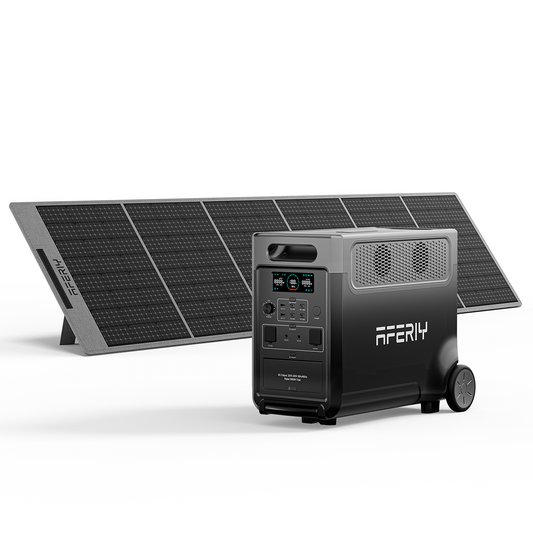
For short power outages, camping or RV use, a mid‑to‑high output portable power station can provide temporary cooling when the AC requirements are within its limits. The AFERIY P280 Portable Power Station provides 2,800W continuous output and 2,048Wh capacity, with expandable capacity up to 10,240Wh. This makes it suitable for users who need to run higher‑power appliances while keeping essential devices such as lights, routers or small appliances connected.

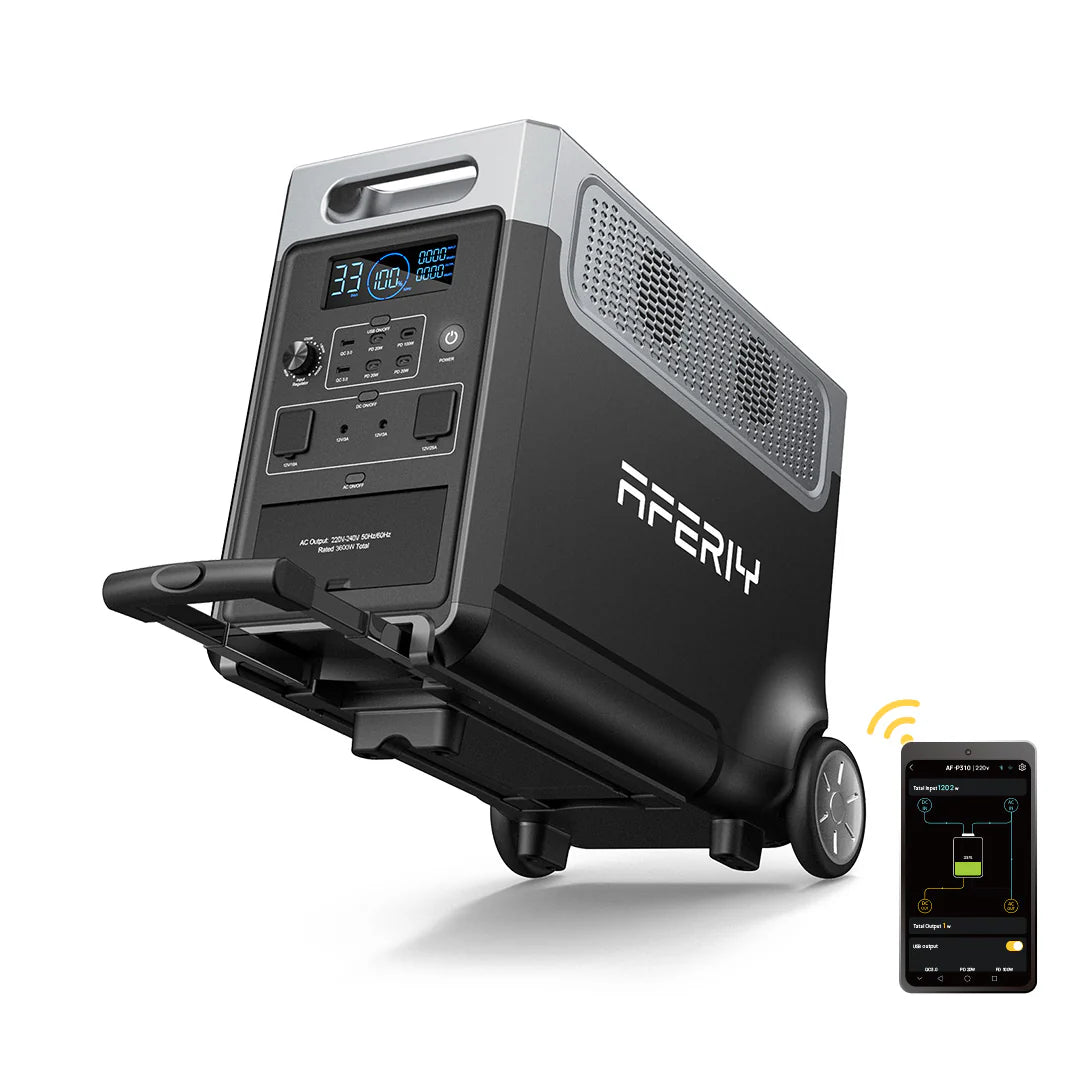
For longer backup situations, the AFERIY P310 Portable Power Station offers 3,600W output and 3,840Wh capacity, expandable up to 11,520Wh, providing more stored energy for extended power needs. It is better suited for users looking for a larger home backup setup rather than occasional portable use.

However, a suitable setup requires matching the AC’s rated input, startup requirements and the power station’s output capability, rather than choosing based only on battery capacity.
How to Reduce Window AC Energy Use
If you’re concerned about electricity bills, changing how the AC is used can be just as important as choosing a lower‑wattage model.
First, select a unit with an appropriate BTU rating for the room. An undersized AC may have to run for longer periods, while an oversized unit is not automatically the most efficient choice.
Next, compare efficiency ratings such as EER or CEER, rather than looking only at BTU or wattage. A more efficient unit can provide the same cooling capacity with less electrical input.
Simple measures also help: keep doors and windows closed while cooling, clean the filter regularly, reduce direct sunlight with blinds or curtains, and use a timer when full‑time cooling is unnecessary. These are practical measures also recommended in guidance from energy‑efficiency sources and competing AC power guides.
FAQs
Do window AC units use a lot of electricity?
They can be a relatively significant household load, particularly when operated for many hours. However, whether window AC units use a lot of electricity depends on the unit’s wattage, efficiency, operating time and how frequently the compressor runs.
Can a window AC run on solar power?
Yes, a window AC can potentially run using a solar generator or solar‑powered system, but the setup needs to provide enough continuous output, startup power and battery storage. The required system size depends on the AC’s wattage, operating hours and whether other appliances are connected at the same time.
Does turning a window AC on and off save electricity?
It depends on the situation. Turning the AC off when cooling is unnecessary can reduce energy use, but frequently switching it on and off during short periods may not always be efficient because the compressor needs to restart. Using a thermostat setting, timer or energy‑saving mode can help maintain comfort while reducing unnecessary operation.
Conclusion
The answer to how many watts does a window air conditioner use is usually somewhere between 500W and 1,500W, but the number on the specification sheet is only part of the picture. BTU determines cooling capacity, efficiency affects electrical demand, and operating time determines total energy consumption.
For everyday use, matching the AC to the room and comparing efficiency ratings can help control running costs. For power cuts or off‑grid situations, the key is to match the AC’s running and starting requirements with both the output rating and Wh capacity of the power station.