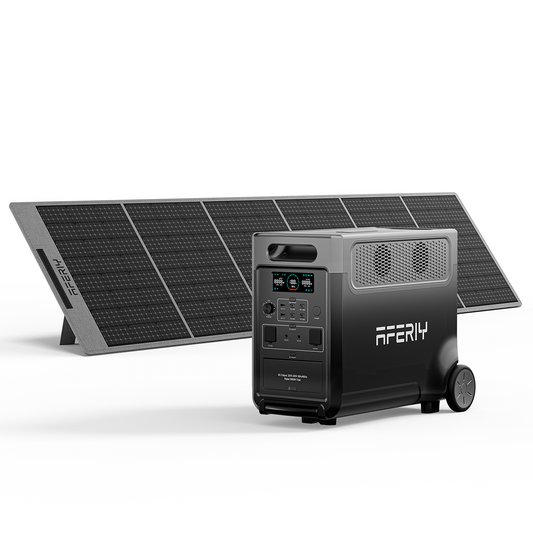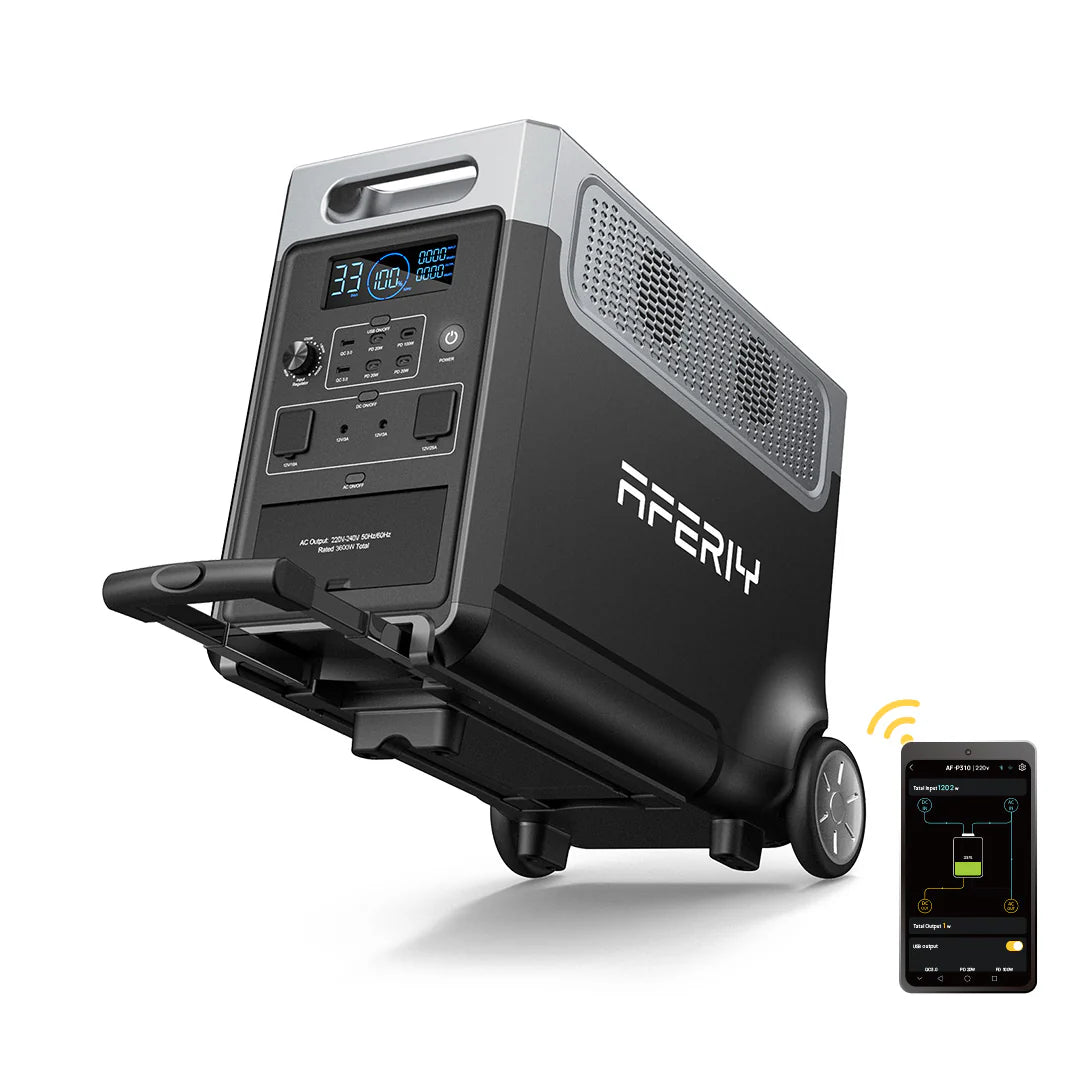


AFERIY P210 vs P280 vs P300: Key Differences Compared
The AFERIY P210, P280 and P300 Portable Power Station all start with a 2,048Wh battery, but they are designed for slightly different needs. The AFERIY P210 Portable Power Station offers 2,400W of continuous output, the AFERIY P280 Portable Power Station increases this to 2,800W and adds expandable storage, while the AFERIY P300 Portable Power Station delivers up to 3,000W.
For UK buyers, the choice comes down to three things: which appliances you need to power, how long you need to run them, and how easily you can recharge the battery. Here is how the three portable power stations compare and what their differences mean in practice.

AFERIY P210 vs P280 vs P300 at a Glance
Although all three AFERIY models share a 2,048Wh LiFePO₄ battery, their output ratings, charging capabilities and expansion options differ. The AFERIY P210 Portable Power Station is designed for users who need a fixed-capacity power station, while the P280 and P300 offer greater flexibility for higher loads and longer periods of use. The table below highlights the key specifications to consider before choosing a model.
| Specification | AFERIY P210 Portable Power Station | AFERIY P280 Portable Power Station | AFERIY P300 Portable Power Station |
|---|---|---|---|
| Continuous AC output | 2,400W | 2,800W | 3,000W |
| Battery capacity | 2,048Wh | 2,048Wh | 2,048Wh |
| Expandable capacity | No | Up to 10,240Wh | Up to 10,240Wh |
| Battery chemistry | LiFePO₄ | LiFePO₄ | LiFePO₄ |
| Maximum AC input | 1,100W | 1,800W | 1,800W |
| Maximum solar input | 500W | 1,200W | 1,200W |
| Maximum combined AC and solar input | 1,600W | 2,000W | 2,000W |
| Approximate AC charging time | 2 hours | 1.5 hours | 1.5 hours |
| Approximate solar charging time | 4.5 hours | 2.5 hours | 2.5 hours |
| Combined AC and solar charging time | About 1.7 hours | About 1.7 hours | About 1.7 hours |
| UPS switchover time | ≤10ms | ≤10ms | ≤10ms |
| Weight | 22kg | 21.6kg | 21.6kg |
| Dimensions | 398 × 280 × 315mm | 398 × 280 × 315mm | 398 × 280 × 315mm |
| Warranty | Up to 7 years | Up to 7 years | Up to 7 years |
The biggest step up is from the AFERIY P210 Portable Power Station to the AFERIY P280 Portable Power Station, with higher output, faster charging and expandable battery capacity. The AFERIY P300 Portable Power Station builds on the AFERIY P280 Portable Power Station with an additional 200W of continuous output, while retaining the same battery capacity, charging inputs and expansion limit. These differences are worth considering alongside your expected power consumption and how often you will have access to a mains supply.
What Do the Differences Mean in Practice?
Output Power: 2,400W, 2,800W or 3,000W?
Continuous output determines how much power a station can supply to connected appliances at the same time. The AFERIY P210 Portable Power Station provides up to 2,400W, compared with 2,800W for the AFERIY P280 Portable Power Station and 3,000W for the AFERIY P300 Portable Power Station.
This matters when running appliances with higher power demands or using several devices together. However, a higher rating does not mean every appliance will be compatible. You also need to account for startup surges from equipment such as refrigerators and pumps.
For example, if your planned load remains comfortably below 2,400W, the P210 may be sufficient. If it exceeds that rating, the AFERIY P280 Portable Power Station or AFERIY P300 Portable Power Station could be a better fit, provided the total load and any startup requirements stay within the relevant limits.
Battery Capacity: How Long Can the Power Last?
All three models have a standard 2,048Wh LiFePO₄ battery. This means that, before accounting for conversion losses and other operating factors, their stored energy is broadly comparable when fully charged.
The distinction is expandability. The AFERIY P210 Portable Power Station has a fixed capacity, while the AFERIY P280 Portable Power Station and AFERIY P300 Portable Power Station can be expanded to 10,240Wh using compatible expansion batteries.
That option is useful if your requirements change. You could start with the standard capacity and add batteries later rather than buying the largest configuration immediately.
It is important to separate power from energy: watts determine the load a power station can support, while watt-hours help determine how long it can run that load. A 3,000W model does not automatically provide longer runtime than a 2,400W model when both have the same battery capacity.
Charging: Mains Electricity or Solar Panels?
Charging flexibility is one of the clearest differences between the AFERIY P210 Portable Power Station and the other two models.
The AFERIY P210 Portable Power Station accepts up to 1,100W of AC input and 500W of solar input. The AFERIY P280 Portable Power Station and AFERIY P300 Portable Power Station both accept up to 1,800W of AC input and 1,200W of solar input.
In practical terms, the newer models can accept more charging power when paired with a suitable source. This may be useful if you need to replenish the battery between trips or want to make better use of a compatible solar array.
The maximum input figures are not guarantees of the power available throughout a charging session. Solar output changes with sunlight, shading and panel orientation, while mains charging depends on the selected settings and available input.
Which AFERIY Model Fits Your Needs?
Everyday Backup and Essential Electronics
If you mainly need to power a laptop, router, lights and other compatible devices during a short power cut, the AFERIY P210 Portable Power Station is a sensible starting point. Its 2,048Wh battery provides stored energy, and its 2,400W output gives you a clear limit against which to check your planned appliance load.

There is little reason to pay for additional output if your equipment does not need it. The key question is whether the fixed battery capacity will cover your expected use before you can recharge.
Longer Power Cuts and Expandable Storage
The AFERIY P280 Portable Power Station is worth considering if you need more output headroom and want the option to increase your stored energy later. Its 1,800W maximum AC input and 1,200W solar input also provide more charging flexibility than the P210.

The AFERIY P300 Portable Power Station makes sense when your planned load requires more than 2,800W but remains within its 3,000W continuous rating. It offers the same standard battery capacity and expansion limit as the AFERIY P280 Portable Power Station, so its higher output should not be mistaken for longer runtime.
Before relying on any portable power station for home backup, list the appliances you want to run, their power requirements and how many hours you expect to use them. This will give you a more useful estimate than choosing a model based on wattage alone.
Caravans, Camping and Off-Grid Use
For camping, caravan trips and other off-grid activities, consider how much energy you need between charging opportunities. Lighting, laptops and small electronics place different demands on a battery from heating appliances or kitchen equipment.
The AFERIY P210 Portable Power Station may be adequate for shorter trips with moderate energy requirements. The AFERIY P280 Portable Power Station and AFERIY P300 Portable Power Station offer greater flexibility if you want to connect a larger compatible solar setup or add expansion batteries for longer stays away from mains electricity.

Check the relevant UK model’s output sockets and the electrical requirements of your caravan or other equipment before connecting it. Do not assume that a particular vehicle connection or onboard electrical system is compatible without checking the product manual.
Should You Upgrade from the P210 to the P280 or P300?
The P210-to-P280 upgrade brings three practical benefits: more continuous output, higher charging input and expandable storage. Those improvements are relevant if you have outgrown the P210’s limits or want more flexibility for future use.
The P280-to-P300 upgrade is more specific. You gain an additional 200W of continuous output, but the standard battery capacity, maximum expansion and headline charging inputs remain the same.
If you are comparing the two higher-output models, focus on the maximum load you genuinely expect to run and the value of the P300’s extra output. If your appliances fit within 2,800W, the P280 may already meet your needs.
Current UK prices can also change the decision. Compare the prices of the configurations you intend to buy, including any expansion batteries, rather than comparing the headline prices of the base units alone.
FAQs
How do I estimate the runtime of an AFERIY 2,048Wh power station?
Start with the total energy consumption of the devices you intend to run. As a rough upper-bound calculation, divide 2,048Wh by their combined wattage. Actual runtime will be shorter because not all stored energy is available to the appliances, and conversion losses and changing loads affect the result.
Can I expand the P280 or P300 straight away?
Both models support expansion to a maximum of 10,240Wh using compatible expansion batteries. Check the current UK product listing and manual for the supported battery configuration before purchasing additional units.
Will a 1,200W solar panel charge the P280 or P300 at 1,200W all day?
No. The 1,200W figure is the maximum rated solar input, not a guaranteed continuous charging rate. Actual solar power varies with weather, shading, panel angle and the specifications of the connected panels.
Can I use these power stations for sensitive electronic equipment?
All three models specify pure sine wave AC output and a UPS switchover time of no more than 10ms. However, these specifications alone do not establish compatibility with every device. Check the equipment manufacturer’s requirements and test your setup before relying on it as backup power.
Conclusion
The AFERIY P210 Portable Power Station is suitable when 2,400W of output and a fixed 2,048Wh battery meet your needs. The AFERIY P280 Portable Power Station is the more flexible choice if you want faster charging, higher output and the option to expand storage. The AFERIY P300 Portable Power Station is worth considering when you need its additional 200W of continuous output.
The best choice is not necessarily the most powerful model. Match the output to your appliances, the battery capacity to your expected runtime, and the charging options to where you will use the power station.