

How to Prepare for a Power Outage in Winter: UK Household Guide
Storm Goretti arrived on 8 January 2026 with a 99mph gust at St Mary’s Airport on the Isles of Scilly, a record for that site, and left enough snow for the Met Office to warn of up to 30cm on high ground in Wales and the Peak District. By the following afternoon around 50,000 properties were still without power, most of them in the South West, after more than 169,000 had been reconnected.
What they faced was not simply a dark evening. In a January cold snap, losing power means losing heat, and a house that loses heat in freezing weather is a different problem from one that has only lost its lights.
The Cabinet Office’s Be Ready campaign, launched in October 2026, sets three days of self-sufficiency as the benchmark for that reason. This guide covers how to prepare for a power outage in winter in a UK home: what fails first, what to fix before a storm, what belongs in the kit, and how far backup power realistically goes.

What Actually Stops When the Power Goes
Most UK homes are heated by gas, so it’s easy to assume the radiators keep going when the electricity doesn’t. They don’t. A boiler needs mains power for the pump that pushes hot water round the system, and for the fan, the ignition and the controls, so a full gas supply buys you nothing without it.
The fridge-freezer starts warming as soon as the compressor stops. Broadband goes down with the router, and a landline that runs through it goes too. Mobile signal often survives, but the phone depends on its battery. In rural areas, water pressure can drop. Anyone relying on a stairlift, a hoist or a home oxygen concentrator loses those as well.
The useful question is which of those your household can absorb for three days, and which need a plan now.
Before the Storm: Getting the House Ready
Start with the building, not the shopping. Insulation and draught-proofing are the cheapest warmth you can buy, and they buy hours once the heating stops.
Close the gaps. Draught-proofing strips on windows and doors, brushes on letterboxes, and heavy curtains drawn at dusk all slow heat loss.
Lag the pipes. Foam lagging on pipes in the loft, garage and any unheated space costs very little. Lag the cold water tank if it sits in the roof and insulate the outside tap.
Find the stopcock. In a burst pipe, the difference between a wet carpet and a flooded house is how fast you can turn the water off.
Book a boiler service. A serviced boiler is less likely to lock out after a cold snap, and if the heating will not fire, a frozen condensate pipe is a common cause, so lag that too.
Save the right number. 105 is free from any phone in England, Scotland and Wales and puts you through to your network operator, the company that fixes the cables, not the one that bills you. In Northern Ireland it is 03457 643643.
An Emergency Kit for a Winter Power Outage
A winter kit is a standard household kit with the warmth side taken seriously. Keep it where you can reach it in the dark, not in the loft.
| Category | What to keep |
|---|---|
| Warmth | Thermal base layers, jumpers, blankets or sleeping bags, hats, gloves, hot water bottles |
| Water and food | Three litres of water per person per day for three days; tinned and packet food that needs no cooking; a manual can opener |
| Light and information | A torch or head torch per person, spare batteries, a battery or wind-up radio |
| Health | First aid kit, seven days of prescription medicines, spare glasses, a copy of repeat prescription details |
| Practical | Cash in small notes, power bank and charging cables, pet food, nappies and formula if needed |
Three litres a day covers drinking and basic hygiene, so add more if you have room. The food should be things the household will eat cold, since most hobs and microwaves need power. Order repeat prescriptions before winter, not during a storm: NHS repeats take a few working days, and a pharmacy without power cannot dispense.
What Backup Power Can and Cannot Do
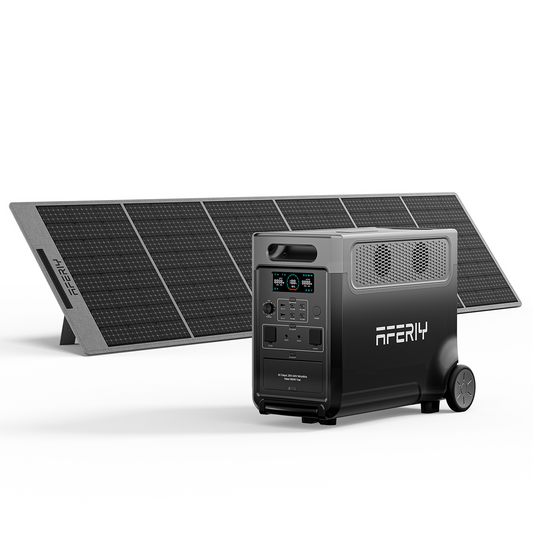
A power bank stretches a phone for a day, but it will not run a fridge overnight, and it cannot run the boiler, which needs a fixed supply rather than a plug. A portable power station covers the middle ground. The AFERIY P210 Portable Power Station stores 2,048Wh in a LiFePO4 battery and delivers 2,400W of pure sine wave output across thirteen sockets and ports: enough in a winter cut for the fridge-freezer, the router, lighting for one room, phones, laptops and an electric blanket. Its UPS function switches to battery within 10 milliseconds, so a plugged-in router or desktop does not drop when the supply fails. With a 200W solar panel it recharges from daylight rather than waiting for the network.

One caveat. A 2kW fan heater will flatten any portable battery in well under an hour, so a power station is not a substitute for central heating. The battery is best saved for the appliances that must run, with warmth left to layers and blankets.
If the Cut Lasts Beyond a Day
Be Ready sets 72 hours as its benchmark, but storms often run longer. After Goretti, more than 40,000 properties in the South West were still off supply the following afternoon, and crews facing scattered faults cannot reconnect everyone at once.
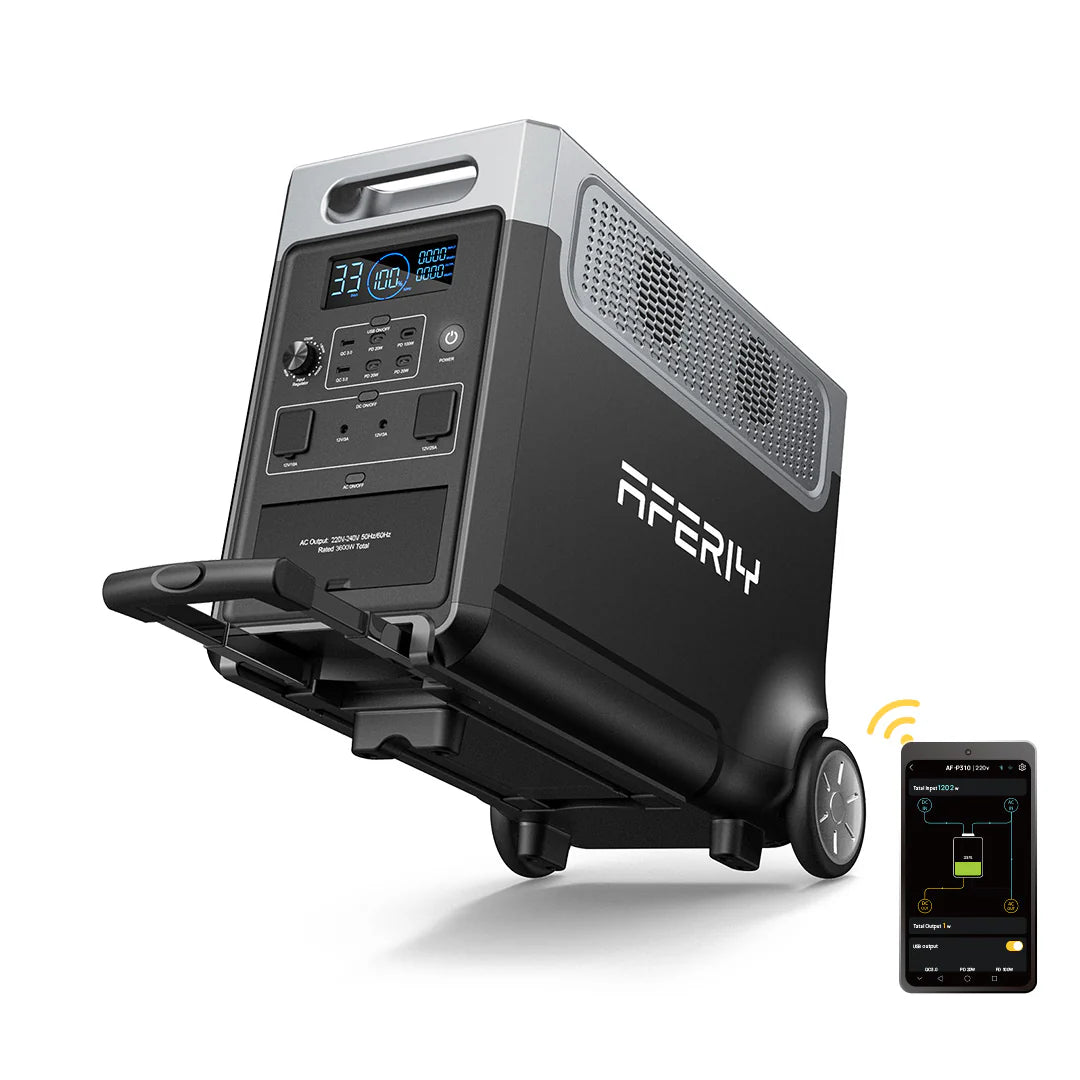
An expandable unit makes more sense past that point. The AFERIY P310 Portable Power Station starts at 3,840Wh, roughly double the P210, with 3,600W of output, and can be extended to 11,520Wh with add-on batteries. It accepts up to 2,000W of solar input, so it can recover during daylight while still powering the house. For a rural property, a coastal village, or a household with medical equipment, the option to add capacity later is what makes a long outage manageable.

Two free things are worth doing before winter. Anyone who depends on power for medical reasons, is of pensionable age, or has young children can join the Priority Services Register, which suppliers run at no cost. And introduce yourself to the neighbours, since the person most likely to notice a vulnerable household is the one next door. One more point: if the supply runs past the limits in Ofgem’s guaranteed standards, you usually have to claim, so note the times it went off and came back.
During the Cut: Warmth, Food and Carbon Monoxide
Pick one room and heat it. Close the doors to the rest of the house, hang a blanket over a draughty doorway, and bring everyone, pets included, into that space. Layers beat one thick jumper, a hat makes a real difference indoors, and a hot water bottle stays warm for hours.
Carbon monoxide is the risk that catches people out. A barbecue, camping stove or generator brought inside, or into a garage, can kill within minutes, and early symptoms look like a cold or flu. Put a carbon monoxide alarm on the same shopping trip as the torch.
Food safety has clear official limits. A cut under four hours is unlikely to affect chilled or frozen food. Beyond that, keep the doors shut: a fridge stays cold for about four hours, and a freezer holds food frozen for up to 48 hours when full, or around 24 hours when half full. If the fridge reaches 8°C, eat the chilled food within four hours or bin it. In cold weather, food can be stored outside in a sealed container, below 8°C.
Before assuming the worst, rule out the obvious: a tripped breaker, a prepayment meter that has run out, or one failed circuit. If the neighbours are out too, it is the network. Report it, leave one light on so you know when it returns, and check on anyone nearby living alone.
After the Power Returns
Give it a few minutes before switching appliances back on, and leave sensitive electronics unplugged until the supply is steady. If you turned the boiler off at the fused spur, switch it back on and check the pressure gauge, which normally reads between 1 and 1.5 bar with the heating off. Timers often lose their settings, so reset the clock before assuming the heating has failed.
Walk round for leaks under sinks and along the loft pipes, bin what the outage spoiled, restock, and put the power station back on charge.
FAQs
Does a power cut stop my gas central heating?
The gas keeps flowing, but the boiler cannot use it. Pumps, fans, ignition and controls all run on mains electricity, so heating and hot water stop until the supply returns. Very old boilers with permanent pilot lights and gravity-fed systems are the exception, and few are left in UK homes. Plan for a cold house.
Is a portable power station safe to use indoors?
For the appliances it is designed to run, yes. It gives off no exhaust fumes, so it can sit in a living room or hallway. Keep it dry, away from radiators and sunlight, and avoid damp sheds where condensation can reach the sockets. It cannot power a gas boiler, and connecting one to fixed wiring needs a qualified electrician.
What should I do if a pipe freezes during a cut?
Turn the water off at the stopcock first, then open the nearest tap so meltwater has somewhere to go. Warm the pipe gently from the tap end back towards the tank, using hot water bottles, warm towels or a hairdryer on low. Never use a blowtorch or pour boiling water on a frozen pipe. If a pipe has split, keep the water off and call a plumber.
Can I keep using insulin or other chilled medicine during a cut?
Most medicines that need refrigeration stay usable in a closed fridge for several hours, but the safe window depends on the product. Read the patient information leaflet or ask a pharmacist before winter, and keep a cool bag and ice packs with the kit. Never place insulin directly against ice.
Conclusion
A UK winter is rarely extreme, but the housing is old, the heating stops with the grid, and restoration after a named storm can take days. Three days of water, food and warmth, plus a way to keep a few essentials running, is what separates a cold inconvenience from a genuine emergency. Start with the house, build the kit, then decide how much backup power you need.